
The age of big questions
Something shifts between 6 and 12. Children stop just doing and start asking why. They want to understand, debate, explore, and figure things out with others.
They’re done with just absorbing. Now they want to take on the world.
The Elementary is built for exactly that. A place where curiosity has room to go deep, and where rigor and independence grow together.

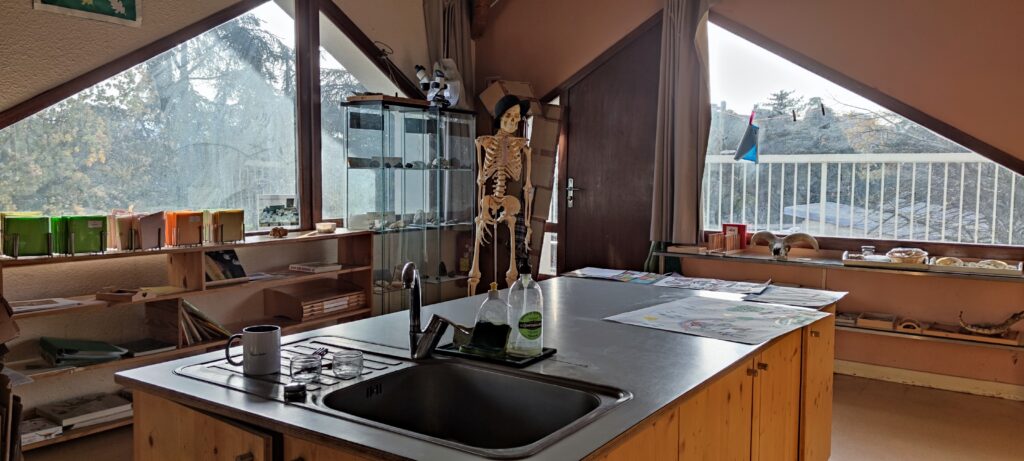
A place where children drive their own learning
- At 6, you watch the older ones. At 10, you become one of them. Mixed ages create a dynamic no conventional classroom can replicate.
- Every child follows a personalized work plan. A genuine individual path, guided by educators who know them well.
- Projects happen in small groups. Real research, real debates, real presentations. The kind of work that teaches you how to work with people.
- Montessori materials open the door. From concrete to abstract, each child crosses that threshold at their own pace.
- By the time they leave, they’ve built something no grade can measure. Perseverance. Confidence. The ability to think for themselves.
What children build between 6 and 12


Core academics
- Reading, writing, grammar, mathematics, history, geography, science, world cultures, digital skills, English, sport.
- The full curriculum, explored in depth.
Organization and independence
- Children plan their own work, manage their time, and take on real responsibilities in the classroom.
- By 10 or 11, most of them are remarkably self-directed.
Expression and critical thinking
- Presentations, debates, research, content creation.
- Children develop their own point of view and learn to express it clearly and respectfully.
Cooperation
- Paired and group projects, peer support across ages, shared responsibility for the space.
- Children learn that working well with others is a skill worth developing.
And starting September 2026, English becomes part of the picture too.
From September 2026, the Elementary begins a gradual transition toward bilingual learning, with the goal of reaching half the curriculum in English. Thomas, one of our educators, is Canadian and bilingual, and brings a lived understanding of navigating between two languages and two cultures.
A typical day here
| Time | Activity |
|---|---|
| 8:30 – 9:00am | Arrival and settling in |
| 9:00 – 9:30am | Small group work planning |
| 9:30 – 11h30am | French, mathematics presentations, or independent work |
| 11:30 – 12:30pm | Lunch |
| 12:30 – 1:45pm | Outdoor play |
| 1:45 – 2h15pm | English |
| 2:15 – 3:00pm | History and geography |
| 3:00 – 3:45pm | Art, reading, or dictation |
| 3:45 – 4:10pm | Tidying up the classroom |
| 4:10 – 4:30pm | Collective reading |


Who is this environment for?
For children who need to understand why
Every subject here connects to something real. History leads to science leads to a question nobody had thought to ask yet.
For children who carry the weight of not knowing
Here, not knowing is where learning starts.
For children whose minds run faster or in unconventional ways
Complex projects, open-ended research, no ceiling on where curiosity can go.
Joining mid-cycle?
It happens all the time. Children arrive at 7, 8, 9, 10, from all kinds of schools. We take the time to observe, welcome them properly, and let them find their feet at their own pace. The group does a lot of the work too.
What families say
“Our children have a genuine love of learning. Every day they come home full of questions, new ideas, and a real hunger to discover the world. Projects like following Samantha Davies during the Vendée Globe this year captivated them completely. They pulled us into their explorations, extending the experience at home through research in geography, science, and the race itself. It’s a real joy to watch them learn with that level of engagement and curiosity.”
— F., parent of children aged 7 and 10
“What this school offers is what the world needs right now. Children who learn to think for themselves, work together, manage their time, adapt, and know who they are. A school that gives meaning to what they learn, and prepares them to face change with confidence and responsibility. We are truly glad she gets to grow up in this environment.”
— E., parent of a 10-year-old
Got questions? We probably have answers.
What about core academics, reading, writing, and math?
We follow the French national curriculum, so yes, children learn to read, write, count, and reason. What's different is the how and the when. Learning happens through hands-on, self-correcting materials rather than direct instruction. And instead of expecting every child to hit the same milestone in the same month, we work in three-year cycles.
Children have time to truly learn, and they usually go further than expected.
How is progress tracked without grades?
Closely. Educators observe each child every day and keep a detailed individual record. Families receive regular updates, and every trimester children choose which activities to share with their parents during an open classroom session. It's a moment most parents really look forward to.
No rankings, no grades, but rigorous and personal tracking.
What if my child goes back to a conventional school?
It happens, and they do just fine. Children who leave tend to adapt quickly, because they already know how to learn, how to organize themselves, and how to work independently. We also prepare the transition with the child and family well in advance, so nobody goes in blind.
How do you handle emotions, conflicts, and getting along?
As part of everyday life, not as a problem to solve. Children learn to name what they feel, express it, and listen to others. All our educators are trained in Nonviolent Communication, so the approach is consistent across every age group. The result is a classroom where conflicts get resolved, not suppressed, and where children genuinely learn to be with each other.
Is it right for gifted children, highly sensitive kids, or very reserved ones?
Often, yes. Montessori tends to work particularly well for children who don't thrive in a competitive or noisy environment, who have strong interests, or who develop unevenly. We speak with every family before enrollment to make sure the fit is right, and when it is, these children often flourish here.
What if my child isn't potty-trained yet?
Not a problem. We welcome children as they are, and potty training is not a requirement to enroll. Bathrooms are located directly within the classrooms, which helps a lot. The process unfolds at each child's own pace, with support and zero pressure.
Do you follow an official curriculum?
Yes. Children acquire all the competencies of the French national curriculum. The difference is that instead of a month-by-month program, we work in three-year cycles. That gives children time to genuinely integrate what they learn, rather than move on before they're ready. And in practice, most of our children go beyond what the curriculum expects. The school is regularly inspected by the national education authority.
Are your educators qualified?
Yes. All educators hold Montessori training for their specific age group, and keep developing through ongoing professional development in observation, group dynamics, Nonviolent Communication, and neurodevelopment. Many also bring experience from previous careers, which adds a lot to the team. And we work hard to keep that team stable, because consistent relationships matter enormously to children.
Is there a cafeteria? After-school care?
Yes. Children can have lunch on-site, in an age-appropriate setting. After-school care is available at midday and in the evening. Full details are on the Contact page.
What are the fees?
Tuition is calculated based on household income, to keep the school accessible to as many families as possible. Full details, including a simulator, are on the Fees and Enrollment page.
Which school calendar do you follow?
We follow the official calendar for the Auvergne-Rhône-Alpes academic region, Zone A, aligned with the academies of Clermont-Ferrand, Grenoble, and Lyon.
Come and see it for yourself.
We welcome new families regularly. Come to an Open House or get in touch with the team. We’d love to meet you.